Types of Energy Storage Battery Systems
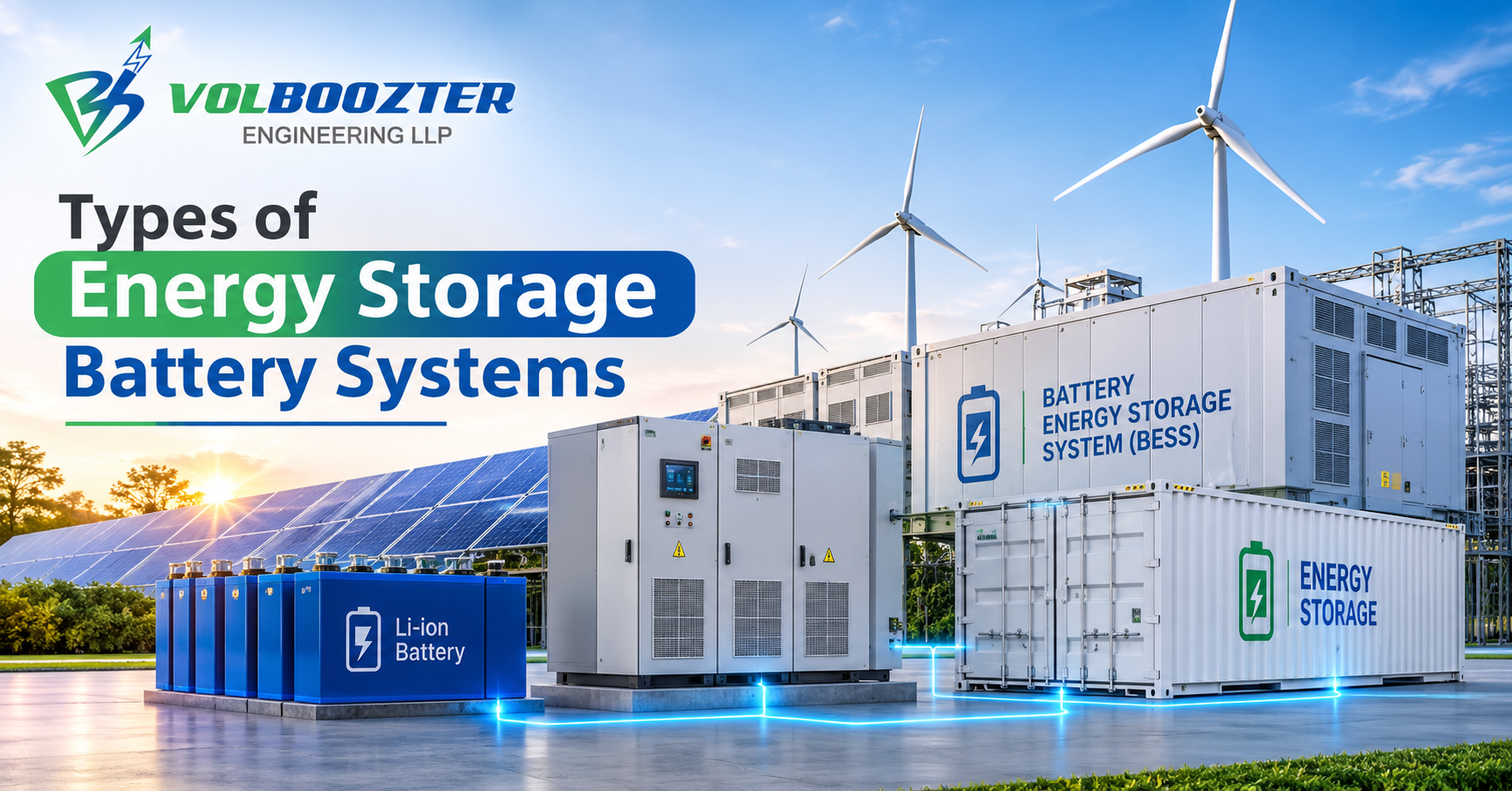
Energy Storage battery systems store electricity for homes, commercial, industrial and power grid use. They enable businesses and power grids to respond to fluctuations in electricity demands, store excess solar energy and provide a backup source of power during outages. But not all batteries are created equal. They can vary in performance, with some being able to deliver high energy density and quick response, but others that can do so over a much longer period, or are more appropriate for industrial backup or long-duration storage. Getting to know the kinds of energy storage battery systems available gives consumers the power to compare the various options and select one that aligns with their energy needs, operating conditions and investment budget.
What Is BESS (Battery Energy Storage System)?
A Battery Energy Storage System (BESS) is a system that stores electrical energy in rechargeable batteries and delivers it when needed. It is charged by grid power, solar power, or other compatible power sources and it discharges that stored power into an electrical load.
A typical BESS comprises four main components
Battery cells: Store energy through electrochemical reactions.
Battery Management System (BMS): Responsible for monitoring the battery and maintaining the cells within a safe operating range.
Power Conversion System (PCS): Electricity flows from AC/DC power supply as needed for charge/discharge.
Energy Management System (EMS): Determines the timing of when the system is charged and/or discharged based on energy demand and system settings.
And the chemistry of the battery cells defines a lot of the system properties such as energy density, charge characteristics, cycle life and operating requirements. The total system design impacts safety, efficiency, reliability and cost.
Types of Energy Storage Battery Systems
Battery Energy Storage Cabinet Systems in India are typically described based on the type of battery chemistry and method of energy storage and discharge. The primary battery technologies are lithium-ion, lead-acid, flow, sodium-ion, sodium-sulfur, and nickel-based batteries. Solid state batteries are also under development.
1. Lithium-Ion Battery Energy Storage Systems
Lithium ion batteries are becoming popular for use in many energy storage applications because of their high efficiency, good energy density and lower maintenance requirements. The lithium ions are able to flow between the electrodes through an electrolyte during a charge or discharge – this process is reversible. Applications for lithium-ion systems include energy storage in the home, in Commercial Energy Storage System in India and industrial buildings, and in utility-scale projects.
Common lithium-ion battery chemistries include:
Lithium Iron Phosphate (LFP): They feature thermal stability and very long cycle life. They are popular in stationary storage applications where safety, longevity and frequent cycling are concerned.
Lithium nickel manganese cobalt oxide (NMC): NMC has a higher energy density than LFP in most architectures. May be appropriate if there are considerations of space available for installation or weight.
Advantages
● High round-trip efficiency
● High energy density
● Limited routine maintenance needed
● Suitable for frequent charging and discharging Designed in modular systems suitable for capacity augmentation
Limitations
● Higher cost upfront than certain other battery chemistries
● Requires appropriate battery management and thermal protection
● Performance and service life is affected by temperature, depth of discharge, and operating conditions
Ideal for: Home energy storage, commercial & industrial loads, peak demand shaving, and grid storage applications.
2. Energy Storage Systems for Lead-Acid Batteries
This is a type of rechargeable battery that is based on lead electrodes and sulfuric acid electrolyte and is capable of converting chemical energy to electrical energy. They are still a good choice for applications where a relatively low up-front purchase price and existing supply chain matters. Their lower energy density and shorter cycle life can limit them for applications which often cycle once a day or more.
There are two basic types of lead-acid batteries
Flooded (wet) lead-acid batteries: Have a liquid electrolyte and, for safety reasons, need adequate ventilation and maintenance.
These batteries are sealed with valves that regulate the pressure. An absorbent glass mat (AGM) and gel are the two types of VRLA batteries most frequently used.
Advantages
● Relatively low upfront cost
● Established and widely available technology
● Suitable for many backup power applications Well-developed recycling infrastructure in many markets
Limitations
● Lower energy density than lithium-ion batteries
● Generally shorter cycle life under frequent cycling
● Due to the physical characteristics of batteries heavier and bulkier for the same usable energy capacity
● Flooded designs need maintenance
Ideal for: UPS systems (both online and offline), emergency backup power, and some off-grid applications where the operating profile and level of maintenance justify the technology.
3. Flow Battery Energy Storage Systems
Flow battery technology employs external energy tanks filled with electrolytes to generate electricity. This electricity generator is connected to external tanks of electrolytes that flow through an electrochemical cell to produce a charge or discharge. Flow batteries differ from traditional batteries in that the majority of their energy is stored in tanks of electrolyte. The architecture of flow batteries thus allows energy storage capacity and power rating to be independently scaled. Vanadium redox flow batteries are an existing example of the technology type of flow battery.
Advantages
● Appropriate for long-term power storage
● The volume of storage can be scaled up through the increase of the electrolyte storage tanks
● Help with repeated cycling
● Electrolyte and power-conversion parts are separable for service and replacement in suitable design.
Limitations
● Lower energy density than many lithium-ion systems
● Requires tanks, pumps, piping, and additional equipment
● Installation may need extra space
● Initial project cost might be a barrier for some applications
Ideal for: Large grid-connected projects such as backup power, renewable energy integration and industrial or commercial applications that need several hours of continuous power supply.
4. Sodium-Ion Battery Energy Storage Systems
Sodium-ion batteries work on the same principle as lithium-ion batteries; however, sodium ions are used to transfer charge between electrodes. Due to its abundance, sodium-ion technology has a lot to offer as an alternative cell chemistry. It has the potential to substitute for lithium and some other materials, depending on the battery cell architecture and supply chain. With the exception of the sodium-ion batteries all of them have a lower energy density than similar sized lithium-ion batteries. If they are cost competitive, available for the intended product, offer the necessary requirements and the technology is mature then yes.
Advantages
● Uses widely available sodium-based materials
● Potential to diversify battery material supply chains
● Promising options for stationary energy storage
● Some designs offer useful low-temperature performance
Limitations
● Generally lower energy density than lithium-ion batteries
● Commercial availability varies by manufacturer and application
● Cost and long term performance will vary according to build rate and cell design
● Most appropriate for: New stationary storage projects and applications where material availability and cost potential, along with system-level performance, take precedence over the highest energy density.
5. Sodium-Sulfur Battery Energy Storage Systems
NaS batteries are high temperature, rechargeable batteries that use sodium and sulfur as the electrode materials with a solid electrolyte between them. Their capacity to hold large quantities of energy makes them appropriate to certain large scale stationary uses. The operation at high temperatures (around 300-350°C) means they also need more complex thermal management.
Advantages
● Suitable for large-scale stationary energy storage
● Able to support energy delivery for hours
● Beneficial to control the energy production and demand in some applications in the grid.
Limitations
● Requires high operating temperatures
● Needs specialised insulation and thermal controls
● Complexity of the system and safety aspects need to be balanced
Applications: Suitable for utility-scale projects and certain niche grid applications where the system's operating requirements and project economics make the technology viable.
6. Nickel-Based Battery Energy Storage Systems
There are a number of different types of batteries that use nickel including: Nickel-cadmium (NiCd). NiCads are the most popular of the nickel based batteries and are very robust allowing them to withstand tough conditions. NiCd batteries are composed of the following:-The electrodes are based on nickel and cadmium. An alkaline electrolyte is used to create this type of battery.
Advantages
● Robust construction
● Good performance in demanding operating environments
● Reliable operation in selected industrial backup applications
● Time proven technology for specific applications
Limitations
● Lower energy density than many lithium-ion batteries
● Cadmium presents significant environmental and handling concerns
● Recycling and disposal require appropriate controls
● Generally more competitive for new large-scale projects
Suitable for: Niche backup industrial systems, remote installations and specialised application areas that require their durability and operating conditions to make their use worthwhile.
7. Solid-State Batteries: A New Technology
This type of battery utilizes a solid electrolyte instead of a liquid one. It is being researched and produced by many developers and manufacturers to increase energy density and safety. It's a technology that's gaining traction, but commercial viability differs dramatically among the designs. Many solid-state batteries have yet to reach the market, and the cost of manufacturing, longevity and degree of scalability must be evaluated before using in a specific storage project.
Potential advantages
● Potential for higher energy density in some designs
● Possible enhancements to safety
● Possibility of using alternative electrode materials
Current challenges
● Manufacturing complexity
● Cost of materials and production
● Durability and performance at commercial scale Limited availability for many stationary storage applications
Ideal for: Research, development and potential future energy storage use once commercially-viable designs emerge.
Comparison of Various Energy Storage Battery Types
The following table shows the main differences between the battery technologies mentioned above.
| Battery type | Main strengths | Key limitations | Typical applications |
|---|---|---|---|
| Lithium-ion (LFP/NMC) | High efficiency; good energy density | Requires thermal and electrical protection | Residential, commercial, industrial, and grid storage |
| Lead-acid | Lower initial cost; established technology | Heavy; shorter cycle life under frequent cycling | UPS and backup power |
| Flow battery | Suitable for long-duration storage; scalable capacity | Large footprint; pumps and tanks required | Grid-scale and renewable energy storage |
| Sodium-ion | Abundant raw material; alternative supply chain | Lower energy density in many designs; developing market | Selected stationary storage projects |
| Sodium-sulf ur | Suitable for large-scale energy storage | High-temperature operation | Utility-scale applications |
| Nickel-cadmi um | Robustness; demanding-conditi on performance | Cadmium-related environmental concerns | Specialised industrial backup |
| Solid-state | Potential for higher energy density and improved safety | Manufacturing and commercialisation challenges | Emerging applications |
Best Battery Technologies for Different Industries
| Industry | Recommended Battery |
| Manufacturing | LFP |
| Textile Mills | LFP |
| Data Centers | LFP/NMC |
| Solar Farms | LFP |
| EV Charging Stations | LFP |
| Utility Projects | LFP / Flow |
How to Choose the Right Battery Energy Storage System
The ideal choice for the most appropriate battery technology in the field will depend on the amount of energy to be stored, the rate at which the energy must be provided, and the frequency of system operation. It is important to consider the following before installing a battery energy storage system.
1. Energy Capacity and Power Output
Capacity, expressed in terms of kilowatt-hours (kWh) or megawatt-hours (MWh), refers to the amount of energy a battery can hold. Power, measured in kilowatts (kW) or megawatts (MW), tells you how much power a battery can provide. For instance, a business that requires the continuous running of critical machinery for a number of hours will have different storage requirements to one that only needs short periods of high power.
2. Needed Storage Time
Think about the duration for which your system should generate power when the power goes out or when the demand is high. Lithium-ion batteries are well suited for projects with need for quick response and multi-hour storage. Flow batteries are potentially appealing for projects with longer discharge needs and high number of cycles. The optimum option will be determined by required operating time, system cost and anticipated working pattern.
3. Cycle Life and Total Cost of Ownership
The cycle life of a battery shows the number of full charge- discharge cycles the battery can manage before it stops working to some level of performance or capacity. But cycle life is only part of the story. When evaluating the best investment, consumers must also take into account capacity, round-trip efficiency, maintenance, replacement costs, warranty, and lifetime. A cheaper battery to purchase could be more expensive in the long run if you have to change it more regularly or it doesn't last as long.
4. Safety and Operating Conditions
The choice of a battery system must be suited to the specific installation environment. Temperature, ventilation, electrical and fire protection, monitoring and accessibility for maintenance can all affect system operation. For commercial and industrial installations, look at the full system, not just battery chemistry. Battery management system, power conversion equipment, installation design and safety standards are also key considerations.
5. Installation Space and Future Expansion
Choosing the right kind of technology may be affected by the available amount of space. Lithium-ion batteries tend to be more efficient in space, whereas flow batteries require space for both electrolyte tanks and equipment.
Conclusion
What's the Most Suitable Battery for Commercial & Industrial Energy Storage? No one battery technology can meet every commercial or industrial facility's needs. The optimal technology will vary based on your facility's load profile, backup needs, electricity pricing structure, space constraints, and operating schedule.
In many applications, lithium-ion batteries - especially LFP - make for solid contenders, offering a good mix of efficiency, cycle life, and modest installed footprint. When long-duration discharge and/or high-cycle life are high priorities, flow batteries can be a valuable candidate.
Lead-acid batteries may still be appropriate for some backup applications, and sodium-ion and other new technologies can provide options as they come to market.
If you need to know more information about BESS Solutions in India feel free to contact us volboozter. we are 8+ Years Experience in the Energy solutions. Volboozter Engineering LLP is an authorized distributor of Battery Energy Storage Systems (BESS) in India for Vinenergo Vinfast. We help industrial facilities, commercial buildings, renewable energy developers, and utility projects implement reliable energy storage solutions for peak shaving, demand management, backup power, and solar integration. Contact our team Volboozter to discuss the ideal BESS solution for your project.